Seasonal Heat Storage for District Heating Networks
Seasonal heat storage can make surplus heat from the summer available for the colder months. The Insight Talk on 15 October 2026 provided an overview of different storage technologies and, using two specific projects in Vienna and Styria, showed how such solutions can be implemented.
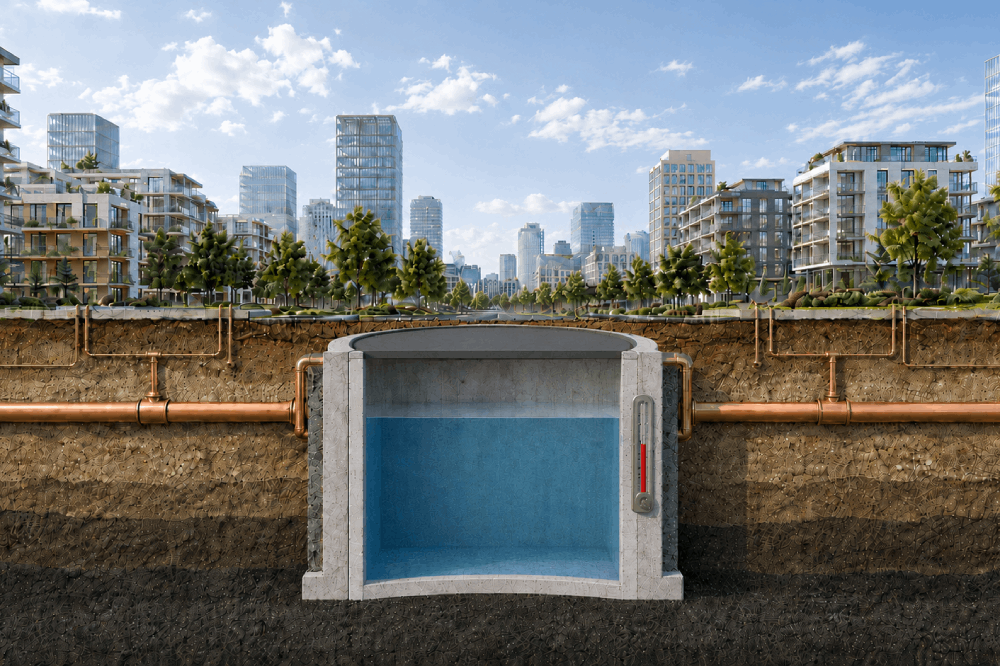
22 October 2026 – Seasonal heat storage can play an important role in making heat available over longer periods of time. While surplus heat can occur during the summer months, demand increases during the colder months. For district heating networks, seasonal storage therefore offers a way to better decouple heat generation and consumption over time and to use different heat sources more flexibly.
At the Insight Talk on 15 October 2026, different storage technologies were presented and two specific projects demonstrated how seasonal storage can be implemented in practice. The focus was on an urban pit thermal energy storage system in Vienna and a heat storage facility in a former basalt quarry south of Graz.
Overview of seasonal heat storage technologies
Ludwig Fliesser from Green Energy Lab opened with an overview of different technologies for seasonal heat storage. The starting point was the seasonal mismatch between heat supply and demand: surplus heat from the summer months can be stored and made available again during the colder months. The technologies presented included hot-water tanks, aquifer and cavern storage, borehole thermal energy storage, molten-salt and solid-material storage, as well as pit thermal energy storage.
Several reference projects illustrated the different ways in which these storage solutions can be implemented. One example was the Theiss hybrid storage system, where a large hot-water storage tank is combined with a power-to-heat system and battery storage. Other examples included aquifer storage, such as the ATES Vienna project, as well as borehole and cavern storage. The overview concluded with pit thermal energy storage systems, which were then explored in greater detail in the two project presentations.
Don’t miss a thing: Register now for our free newsletter!
ScaleUp: Pit thermal energy storage for urban areas
Marieluise Pöschko-Reinweber from Wien Energie presented the ScaleUp project. At its core is a pit thermal energy storage system designed specifically for urban areas that is intended to contribute to the decarbonisation of Vienna’s district heating system. The background is the planned expansion of deep geothermal energy and large-scale heat pumps, as well as the diversification of heat sources. Seasonal storage is intended to help make the district heating system more flexible and efficient.
For ScaleUp, a pilot is planned at an existing Wien Energie site in Vienna’s 22nd district. The existing infrastructure provides good conditions for the further expansion of renewable district heating. A key element of the project is a usable and walkable cover surface. A modular floating cover has been developed and tested for this purpose.
The project is also examining different materials, technical feasibility and various operating strategies. Comprehensive monitoring is intended to provide insights into efficiency and CO₂ impacts. The experience gained from development and implementation is expected to support the further development of the technology for larger-scale applications in urban areas.
Sonnenspeicher Süd: Seasonal heat storage in a basalt quarry
Project Manager Michael Reisenbichler-Sommerhofer presented the Sonnenspeicher Süd project south of Graz. At its core is a former basalt quarry that is to be developed into an underground heat storage facility containing around 1.5 million m³ of water and providing a storage capacity of approximately 115 GWh.
The overall system combines several technologies. Solar thermal energy is planned as the main heat source, complemented by heat pumps and a biomass heating plant for additional heating. A new district heating pipeline approximately four kilometres long is intended to connect the site to the existing district heating pipeline between Mellach and Graz.
The storage facility is designed to be used differently depending on its temperature level. When the storage temperature is sufficiently high, heat can be supplied directly to the district heating network. As the temperature in the storage facility decreases, heat pumps take on a greater share of the temperature lift; where necessary, the biomass heating plant provides additional heating. In this way, large-scale heat storage facilities can connect different heat sources and provide additional flexibility for district heating systems.
Presentations for download
- Project ScaleUp: an innovative, scalable pit thermal energy storage system for urban areas to decarbonise district heating – Marieluise Pöschko-Reinweber (Wien Energie) – German only
- Sonnenspeicher Süd: From a basalt quarry to the world’s largest seasonal heat storage facility – Michael Reisenbichler-Sommerhofer (Project Manager) – German only
Unless otherwise stated, the rights to the presentations remain with the respective speakers. The presentation materials are provided exclusively for review and viewing purposes. Publication or use in presentations by third parties is not permitted.
You are currently seeing a placeholder content of YouTube. To access the actual content, click on the button below. Please note that data will be passed on to third-party providers.
Contact
Ludwig Fliesser
Communications Manager
T: +43 676 471 93 47
E: ludwig.fliesser@greenenergylab.at