QuantEEFlex – Quantifying the economic value of energy flexibility in urban districts
Flexibility potential and grid-aware operation of districts with a focus on local heating grids
This project has been completed. Access the QuantEEFlex Publishable Final Report here.
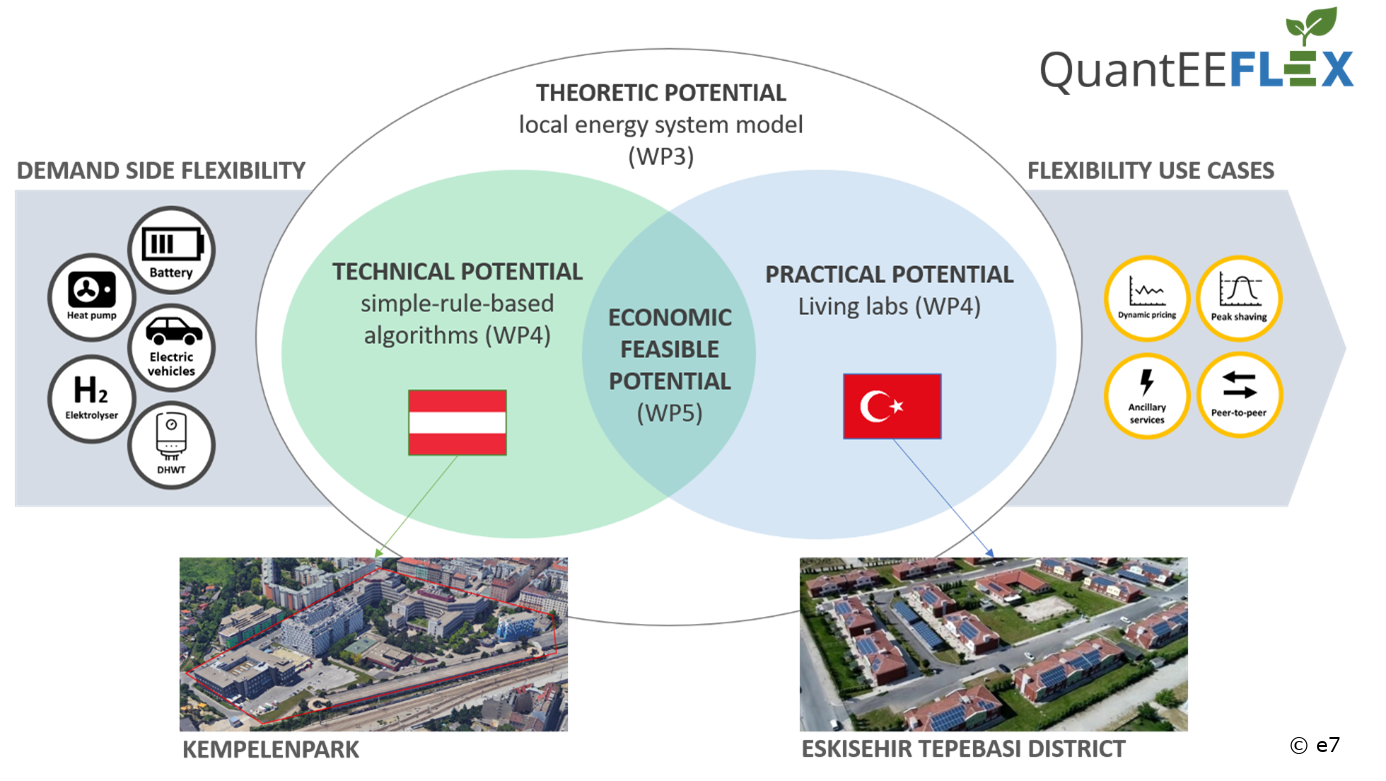
QuantEEFlex investigated how flexible loads and storage can help districts use renewable electricity more effectively, reduce peak demand and lower energy costs. The project focused on heat pumps and building thermal mass, photovoltaics, battery storage, electric mobility and local electricity sharing.
For the Austrian Living Lab at Werk Möllersdorf, e7 developed a digital planning approach combining building simulation with optimisation. The analysis showed that price-responsive heat-pump control can reduce costs, but energy use and thermal comfort must be considered together. A key result was that organisational solutions can create more value than additional hardware. In the assessed area, collective self-consumption increased PV self-consumption from and self-sufficiency, so annual electricity costs fell by around 11 %. Battery storage, by contrast, generated only limited savings and was not economically viable under the assessed conditions.
In the Turkish Living Lab in Eskişehir, PV systems, two batteries and a V2G-capable charging station were operated jointly. A hybrid energy-management approach combined optimisation with simple rules: the larger battery handled load shifting and peak reduction, while the smaller unit smoothed grid fluctuations. This improved PV utilisation and grid operation while avoiding unnecessary battery cycling.
The project resulted in a transferable planning approach. It helps developers, planners and distribution system operators define metering, data access, control strategies and responsibilities early and assess investments on a sound basis.

© JPP ERA-NET SES
This project has received funding in the framework of the joint programming initiative ERA-Net Smart Energy Systems’ (www.eranet-smartenergysystems.eu) focus initiative, Digital Transformation for the Energy Transition, with support from the European Union’s Horizon 2020 research and innovation programme.