Digitalization for Heating Networks: How Data Supports Their Planning and Operation
At the Green Energy Lab Insight Talk on June 10, 2026, experts from Energie Klagenfurt, Wien Energie, and AEE INTEC shared fascinating insights into how digital solutions can support the planning, operation, and further development of district heating networks.
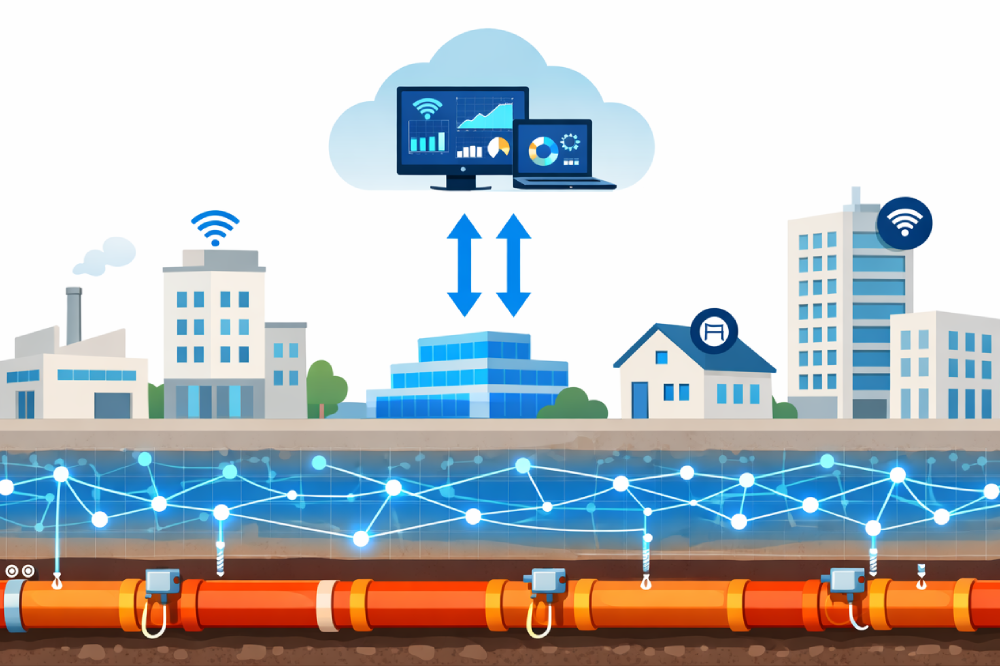
15 June 2026 – The heat transition presents new challenges for heating networks. Renewable heat, waste heat, and storage must be integrated, supply security must be ensured, and the networks must be operated efficiently and economically. The more complex the heat supply becomes, the more important it is to examine the underlying data: Where does the demand for heat arise? What is the potential for expansion? How can generation, storage, and consumption be coordinated? How can operations be managed efficiently?
This is exactly where digitalization comes into play. Digital tools can help identify opportunities for expansion, provide a better understanding of heating networks, and enable more informed decision-making in planning and operations. They lay the groundwork for integrating various data sources, better forecasting future trends, and making day-to-day operations more efficient.
The Green Energy Lab Insight Talk on June 10, 2026, focused on the topic of digitalization for heating networks. Presentations covered a wide range of topics, from GIS-based analysis tools for smart expansion planning and data-driven operational optimization of urban district heating networks to digital models for climate-resilient heating networks and optimized operational strategies.
Smart Expansion Planning: The Case of Stadtwerke Klagenfurt AG
Under the title “District Heating That Finds Its Way,” Moritz Hofbauer from Energie Klagenfurt presented Stadtwerke Klagenfurt AG’s online GIS application “HeatXplorer” during the Insight Talk. The starting point was the previously time-consuming manual evaluation, analysis, and processing of heterogeneous data, which served as the basis for district heating expansion planning in Klagenfurt. The goal of the application is therefore to provide solid support for future expansion planning through automated data processing and intelligent analysis tools. As a user-friendly, simple, and effective online application, it offers a sound basis for decision-making regarding the further development of the district heating system.
The application is based on two key components: an automated database and an online application. The database continuously processes information from internal and external sources, handles input data, and makes it available for further use. In the online application, the results can then be viewed and analyzed depending on user permissions. In addition to the standard functions of GIS applications, the focus is primarily on two main areas: network expansion planning and network densification. The application areas of “HeatXplorer” include, among others, targeted district heating expansion, CO₂ monitoring, and intelligent expansion planning.
How digitalization is optimizing urban district heating networks in Vienna
In her presentation, Ines Lindmeier from Wien Energie provided insights into the use of digitalization to optimize the operation of urban district heating networks, using Vienna as an example. She began by introducing the Vienna heating network and then went on to discuss the secondary networks in greater detail, as well as their efficient operation and maintenance. She then highlighted the City of Vienna’s goal of decarbonizing its heat supply by 2040.
The focus shifted from the question of how to achieve the goal to the handling of data: To this end, existing data sets were analyzed and harmonized, and supplemented with new data sources such as IoT applications and plant data. Another key objective was to make the data scalable and usable, thereby creating tangible added value for grid operations.
Using a real-world example, Ines Lindmeier demonstrated how a digital twin was implemented in collaboration with the companies Noda and Gradyent, based on 100 percent smart heat meters. This made it possible to lower the supply temperature, while also highlighting the close interplay between supply and return temperatures. Further tests on networks of varying sizes showed that flow temperatures could be reduced in all networks and return temperatures in nearly all networks. A key lesson from recent years is that simply storing data is not enough. Data quality, internal expertise, sufficient resources and time, scalability, standardization, and data governance are crucial. Perseverance, a shared understanding of the complexity, and commitment at all levels are also essential.
Using digital models to create climate-resilient heating networks
Xhoi Zhupani from AEE INTEC focused on digital modeling for the development of climate-resilient heating networks and optimized operating strategies. He began by highlighting the challenges facing the heating sector, such as a growing and increasingly complex pool of generators, the integration of new technologies like heat pumps and solar thermal systems, and the optimization of operations with increasing system complexity. For operators, the key question is how to ensure long-term planning security despite existing uncertainties.
As a potential solution, he presented a concept centered on a digital representation of the actual heating network. The aim is to provide operators with a basis for making long-term decisions and further developing heating networks to ensure security of supply, renewable energy, and resilience. The underlying methodology comprises the following steps: status quo analysis, model development and validation, GIS-based analysis, scenario design, simulation, and an overall assessment.
Using two examples, Xhoi Zhupani demonstrated how this methodology can be applied in practice: In the Weiz-Gleisdorf region, researchers are exploring the development of an intermunicipal heating network that hydraulically connects existing networks and enables the shared use of generation and storage infrastructure. In a project in Murau, the focus is on how surplus electricity production can be used to generate heat and feed it into the heating network.
All presentations available for download
- District heating that finds its way – using Stadtwerke Klagenfurt AG’s HeatXplorer for smart expansion planning – Moritz Hofbauer (Energie Klagenfurt) – German only
- Digitalization for the operational optimization of urban district heating networks: The case of Vienna – Ines Lindmeier (Wien Energie) – German only
- Digital models for the development of climate-resilient heating networks and optimized operating strategies – Xhoi Zhupani (AEE INTEC) – German only
You are currently seeing a placeholder content of YouTube. To access the actual content, click on the button below. Please note that data will be passed on to third-party providers.
Contact
Ludwig Fliesser
Communications Manager
T: +43 676 471 93 47
E: ludwig.fliesser@greenenergylab.at